
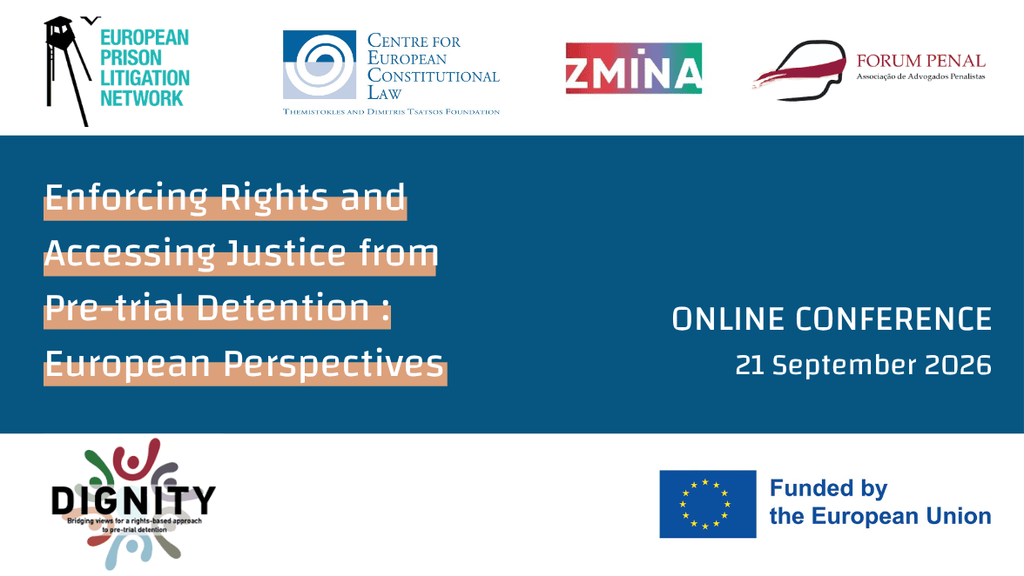
We are pleased to invite you to join an online conference on prisoners’ access to justice on Monday 21 September from 13:00 to 19.00 CET.
With simultaneous interpretation in English, French, Greek, Portuguese and Ukrainian.
Register now >>
The recognition of prisoners’ access to justice, under the influence of the case law of the European Court of Human Rights, has been a central achievement of the past two decades from the perspective of individual rights, and a key driver of domestic efforts to address systemic problems in prison systems. However, little attention has been paid to the practical conditions that enable prisoners to exercise that right and transform rights’ violations into legally articulated claims capable of persuading a judge.
How do prisoners gain access to relevant legal information to identify rights violations, in a field where domestic, European and international legal frameworks overlap? How do they navigate multiple procedures, each with its own admissibility criteria and rules? How do prisoners secure evidence and deal in practice with the adversarial relationship created by legal proceedings against the prison administration?
Building on findings of the project DIGNITY conducted by the Center for European and Constitutional Law, the European Prison Litigation Network, the Human Rights Center ZMINA and Forum Penal – Associação de Advogados Penalistas, the present event aims to answer these questions by highlighting the structural, procedural and financial barriers impeding prisoners’ effective access to legal assistance across Europe and underscoring the crucial role played by external actors, in particular lawyers, in securing access to justice from within detention.
The discussions also aim to address the cornerstone role of lawyers in “upholding the rule of law, securing access to justice and ensuring the protection of human rights and fundamental freedoms” [1] in the current political context, where criminal justice issues tend to be instrumentalised for political gain at the cost of the fundamental principles of the rule of law. While mobilisation at the national level is necessary, collective action to reinforce procedural rights through international instruments is equally essential to establish common safeguards. Several instruments aiming to guarantee prisoners’ access to justice exist [2] but either their scope is limited or their non-binding nature leaves a wide margin of appreciation to States. They also appear increasingly ill-suited to an evolving European criminal policy landscape. [3]
KEY SPEAKERS :
- Nancy Dekens, Secretary of the Netherlands Association of Criminal Defense Lawyers
- Benoît David, Member of the Paris Bar Council
- Vânia Costa Ramos, Chair of the European Criminal Bar Association, member of the European Committee for the Prevention of Torture
- Dmytro Yagunov, Member of the European Committee for the Prevention of Torture
- Marc Nève, President of the Belgian Central Prison Monitoring Council
- Hanna Skrypka, Lawyer at the NGO Protection for Prisoners of Ukraine
- Mariarosaria Guglielmi, President of European Judges for Democracy and Liberties / MEDEL
- Corentin Durand, Researcher at the French National Centre for Scientific Research / CNRS
- Marina Daliani, Vice President of the Hellenic League for Human Rights
- Salvador Guerrero, Chair of the Criminal Law Committee of the CCBE
- Pascal Montfort, Judge at the French Court of Cassation
- and more…
The full programme will be published shortly on this page.
[1] Council of Europe, Convention for the Protection of the Profession of Lawyer, 2025, Preamble.
[2] E.g., UNODC, United Nations Principles and Guidelines on Access to Legal Aid in Criminal Justice Systems, 2013; European Commission, Recommendation on procedural rights of suspects and accused persons subject to pre-trial detention and on material detention conditions, 2022.
[3] Penal policy experts analyse the recent upward trajectory of prison population rates, after a decade-long decline, as “the potential beginning of a new phase in European penal policy”. See Marcelo F. Aebi & Edoardo Cocco, Prisons and Prisoners in Europe 2025: Key Findings of the SPACE I survey, 2026, p. 28.
IN PARTNERSHIP WITH


This event is organised within the framework of the project “DIGNITY: Bridging Views for a Rights-Based Approach to Pre-Trial Detention”, funded by the European Union.

Funded by the European Union. The views and opinions expressed are those of the organisers and speakers only and do not necessarily reflect those of the European Union or the European Commission. Neither the European Union nor the European Commission can be held responsible for them.